


A Franciscan Gospel Reflection for the Third Sunday of Lent 2026 is shared here for your prayer. What are some of the things which you could say you thirst for today?
The Gospel background and reflection questions are prepared and distributed by Franciscan Sister of Christian Charity Sister Anne Marie Lom, OSF and Joe Thiel, as edited from Reflections authored by Fr. Paul Gallagher, OFM. The excerpts from the Sunday readings are prepared by Joe Thiel. To read or download the complete pdf with excerpts for your prayer, please click here: Franciscan Gospel Reflection March 8 2026
Excerpts from the Lectionary for Mass for Use in the Dioceses of the United States of America, second typical edition © 2001, 1998, 1997, 1986, 1970 Confraternity of Christian Doctrine, Inc., Washington, DC. Used with permission. All rights reserved. No portion of this text may be reproduced by any means without permission in writing from the copyright owner
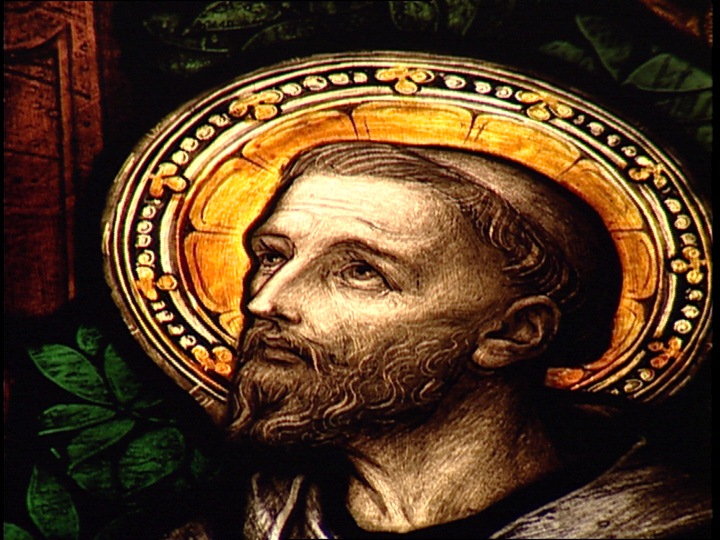
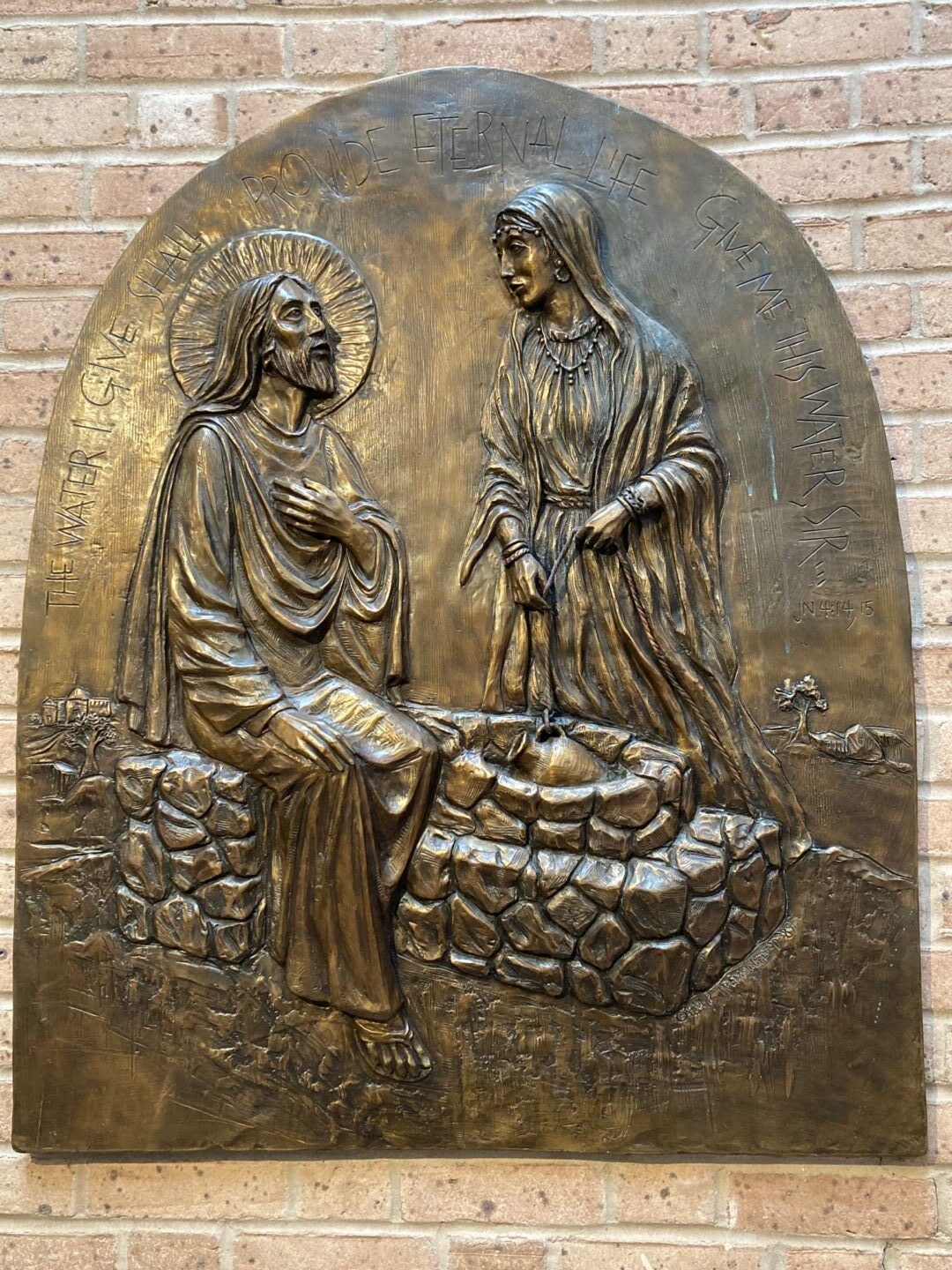
Photos: Dominican Sister of Houston, Texas Sister Mary Peter Tremonte OP, was a sculptor and liturgical designer whose work is found in over 60 churches throughout the country. Founder of the Dominican Institute of the Fine Arts in Florence, Sister Mary Peter included in her works over 22 life size or larger than life size sculptures, stained glass pieces, twelve large bas reliefs in bronze or marble, and other works too numerous to mention. Second photo is taken by Franciscan Sisters of Christian Charity at Co-Cathedral of the Sacred Heart, Galveston-Houston.
John 4:5-42 (The text in italics is omitted in the short form of the Gospel.)
Jesus came to a town of Samaria called Sychar, near the plot of land that Jacob had given to his son Joseph. Jacob’s well was there. Jesus, tired from his journey, sat down there at the well. It was about noon. A woman of Samaria came to draw water. Jesus said to her, “Give me a drink.” His disciples had gone into the town to buy food. The Samaritan woman said to him, “How can you, a Jew, ask me, a Samaritan woman, for a drink?” (For Jews use nothing in common with Samaritans.) Jesus answered and said to her, “If you knew the gift of God and who is saying to you, ‘Give me a drink,’ you would have asked him and he would have given you living water.” The woman said to him, “Sir, you do not even have a bucket and the cistern is deep; where then can you get this living water? Are you greater than our father Jacob, who gave us this cistern and drank from it himself with his children and his flocks?” Jesus answered and said to her, “Everyone who drinks this water will be thirsty again; but whoever drinks the water I shall give will never thirst; the water I shall give will become in him a spring of water welling up to eternal life.” The woman said to him, “Sir, give me this water, so that I may not be thirsty or have to keep coming here to draw water.”
Jesus said to her, “Go call your husband and come back.” The woman answered and said to him, “I do not have a husband.” Jesus answered her, “You are right in saying, ‘I do not have a husband.’ For you have had five husbands, and the one you have now is not your husband. What you have said is true.” The woman said to him, “Sir, I can see that you are a prophet. Our ancestors worshiped on this mountain; but you people say that the place to worship is in Jerusalem.” Jesus said to her, “Believe me, woman, the hour is coming when you will worship the Father neither on this mountain nor in Jerusalem. You people worship what you do not understand; we worship what we understand, because salvation is from the Jews. But the hour is coming, and is now here, when true worshipers will worship the Father in Spirit and truth; and indeed, the Father seeks such people to worship him. God is Spirit, and those who worship him must worship in Spirit and truth.” The woman said to him, “I know that the Messiah is coming, the one called the Christ; when he comes, he will tell us everything.” Jesus said to her, “I am he, the one who is speaking with you.”
At that moment his disciples returned, and were amazed that he was talking with a woman, but still no one said, “What are you looking for?” or “Why are you talking with her?” The woman left her water jar and went into the town and said to the people, “Come see a man who told me everything I have done. Could he possibly be the Messiah?” They went out of the town and came to him. Meanwhile, the disciples urged him, “Rabbi, eat.” But he said to them, “I have food to eat of which you do not know.” So the disciples said to one another, “Could someone have brought him something to eat?” Jesus said to them, “My food is to do the will of the one who sent me and to finish his work. Do you not say, ‘In four months the harvest will be here’? I tell you, look up and see the fields ripe for the harvest. The reaper is already receiving his payment and gathering crops for eternal life, so that the sower and reaper can rejoice together. For here the saying is verified that ‘One sows and another reaps.’ I sent you to reap what you have not worked for; others have done the work, and you are sharing the fruits of their work.”
Many of the Samaritans of that town began to believe in him because of the word of the woman who testified, “He told me everything I have done.” When the Samaritans came to him, they invited him to stay with them; and he stayed there two days. Many more began to believe in him because of his word, and they said to the woman, “We no longer believe because of your word; for we have heard for ourselves, and we know that this is truly the savior of the world.”
Background:
Among Scripture scholars there is some doubt about the historical basis for this encounter at the well. There is no evidence in the other three Gospels that Jesus ever traveled into Samaria. In fact, in the Gospel of Matthew, when Jesus is sending out the apostles, he forbids them to venture into pagan or Samaritan regions. “Jesus sent out these twelve after instructing them thus, ‘Do not go into pagan territory or enter a Samaritan town. Go rather to the lost sheep of the house of Israel (Matthew 10:5-6).’” However, there is evidence the apostles themselves went into the Samaritan areas. In the Acts of the Apostles, after the stoning of Steven, Philip went to Samaria to proclaim Jesus as the Messiah (Acts 8:5).
This Gospel text itself turns on the images of water, faith, light, life, and death. The Church has chosen this text to help those preparing for Baptism at the Easter Vigil to reflect on these elements of our faith. This Gospel also helps the entire Christian community to reflect on our own faith journeys that led all of us to accept Baptism.
A key element in the story is the breaking of traditionally accepted norms of behavior. As the woman herself notes, Jesus should not have spoken to an unescorted woman and a Samaritan. But she should not have been at the well in the middle of the day either. In this society that was strictly gender-separated, women went to the well in the morning and evening, and men went during the day. However, the other women of the town probably did not accept this woman because of her relations with men. In the initial interaction it is Jesus who engages her by asking for a drink. He then continues to engage her in conversation about issues that men only discussed with other men. As their discussion unfolds, there are several places where Jesus could break off their conversation, but he does not. Again, social norms are broken when the woman goes into the town to tell others about her encounter with Jesus. The marketplace where the men of the community would have gathered was also gender-separated. Her presence there would be another break with traditional norms of moral behavior of the day.
Why would Jesus behave in such a way that would cause scandal and jeopardize his credibility? John hints at the answer in Jesus’ response to the disciples when they return. They find Jesus speaking with the woman, and they wonder why he would be talking to her, but they do not ask. Instead, when she goes to tell the others, they urge him to eat something. He declines, telling them: “I have food to eat of which you do not know. My food is to do the will of the one who sent me and to finish his work.” Jesus does not need their food because he draws a different kind of sustenance from doing the will of the Father.
Jesus stopped at this well with his disciples because he was thirsty from their journey, and he was probably hungry as well. As the text unfolds, his human hunger and thirst lead him into a hunger and thirst for the food and drink that can only satisfy through doing God’s will. The journey from human desire to God’s desire is unfolding in both Jesus and the woman.
As the catechumens prepare for their Baptism, they, too, are being invited to reflect on how human desires have led them to desire deeper things, the things of God. They are being invited to experience, in Jesus, the God who deeply desires to stop and encounter all who are thirsting and hungry. We who are baptized into the water of life have already discovered this reality. We now take on penance and sacrifices to again experience our human thirsting and hunger, which leads, once more, to the waters of Baptism and to the table of the Eucharist.

- Can you recall a time in your life when you were truly thirsty? Recall as much of the circumstances around that experience as you are able. How was that thirst satisfied?
- Have you had the experience of being hungry or thirsty when something else comes to your attention and you forget about your hunger or thirst?
- What are some of the things which you could say you thirst for today?
- What are some of things people around you thirst for?
- If you extend that image into the world or even onto the earth itself, what are the things for which they thirst?
- Later, as John tells of the events of the passion, he will say: “…aware that everything was now finished, in order that the scripture might be fulfilled, Jesus said, “I thirst.” (John 19: 28) How do you hear that statement in light of this text?
- Can you consider that God thirsts? What is it that God might thirst for?
- When the disciples offer Jesus something to eat, he responds “I have food to eat of which you do not know.” Have you had the experience of doing God’s will in a way that left you with a sense of being full or rich, in way that food, even a great banquet, does not?
- Can you take time to talk with God about the ways you experience being thirsty, your barriers to responding to the thirst of another, or maybe the image of a God who thirsts?
The post Third Sunday of Lent 2026 Franciscan Gospel Reflection appeared first on Franciscan Sisters.